There's no better celebration of any season than the decorated tree adorned with the rich symbolism of nature—my ritual to inform and inspire you in the journey called life.


Saturday, April 30, 2011

trees in the abbey


WHEN SEEING the "avenue of trees" in Westminster Abbey for the royal wedding of Prince William and Kate Middleton this past Friday morning, I smiled about the significance of this in signaling a new era. I also immediately thought of the influence of The Prince of Wales' book I read recently entitled Harmony with the subtitle, A New Way of Looking at Our World, may have had on the wedding. Prince Charles's book is a scholarly work that fuses the disciplines of sacred geometry in architecture with science and technology of today within every realm of our lives, in which he makes a very conclusive call-to-action: "We stand at an historic moment, we face a future where there is a real prospect that if we fail the earth, we fail humanity. To avoid such an outcome, which will comprehensively destroy our children's future or even our own, we must make choices now that carry monumental implications." From the inside flap of the book jacket: "The book examines how mankind has abandoned its ancient balance with Nature and how rediscovering that balance is the key to solving our most devastating environmental issues." It goes on to say, " Harmony exposes the patterns of the natural world, which for centuries were woven into the fabric of human life, have been lost in the modern age." 

PRINCE CHARLES delves deeply, forcefully—dare I say bravely—into these inter-connected subjects and has created a most thoughtful clarion call for humanity to change back to a more sustainable and regenerative way of living. He suggests that it isn't impossible—but in fact, imperative—to get back to a more natural way of living, from the spaces we build to live and work to the ways we grow and farm our food.

Photograph ©Reuters/Sang Tan
IN KEEPING with this mode of thinking, according to a UK Press Association article, Florist Shane Connolly, the artistic director of flowers for the royal wedding, said he chose the trees to reflect the "medieval ethos" of Westminster Abbey. "These wonderful curved ceilings are supposed to reflect the branches of trees and that was when I thought of having trees in the abbey," he said. I have to wonder if he had also read Charles's book. The Gothic ribbed vaulting of the church certainly echoes the limbs of a tree canopy, although at a much grander scale than the trees, which form a canopy at a more pedestrian level.
Photograph ©Murray Sanders
FOR THE WEDDING, the aisle of Westminster Abbey leading to the altar was lined with six English field maples  (Acer campestre) and two Hornbeam trees  (Carpinus betulus) which were all around 20-25 feet tall. The trees were the most breathtakingly prominent feature of the floral displays focused on growing, rather than cut plants.
As for the significance of these particular types of trees, the English field maple (the only maple native to Britain) symbolizes humility and reserve (and was used to make loving cups in medieval times). And the hornbeam signifies strength and resilience because its wood is very hard and durable. 
Henry VII vault detail (westminster-abbey.org)

THE SEASONAL flowers shrubs and trees in hues of green and white for the wedding decor were mainly sourced from royal estates. It was suggested by the bride-to-be that it had to be British, seasonal and as organic and sustainable as possible. The plan for the trees after being on display in the church for the public until May 6th is for them to be planted at Highgrove, Charles's residence in western England. Other plants and such were to be donated to charity and planted elsewhere.
THE ROYAL FAMILY has been much-derided for the the lives they lead, but they are all in a singularly unique position to be ambassadors for a better world. Their lives, although cushioned with the riches that come with royalty, are not their own really. They live under extreme public scrutiny and really have no power except for the freedom to be somewhat unencumbered from politics-as-usual simply because of their standing as a royal family. I think this is what allowed Charles a strongly pro-earth perspective for the aforementioned book. In the book, he didn't mince words when outlining what needs to change.
IT WAS REFRESHING to see the simple beauty of trees magically forming an intimate human-sized canopy in Westminster Abbey for the royal wedding. I wish Prince William and his newly titled Duchess of Cambridge all the best in becoming shining examples of humility and honor in their richly decorated lives. Their beautiful and understated wedding (as these affairs go when the whole world is watching) has certainly given a strong signal that this might very well be the case.

CROWN JEWELS | (Top) These crown and cross ornaments have been a part of my collection for a number of years—so-long so, I don't recall where I purchased them. The crown, much unlike the real crown jewels, is made of pressed tin and accented with a faux pearl at the top. The Celtic cross ornament is quite royally embellished with colored glass stones and metallic zari thread. The ornaments are flanked with what I believe to be hornbeam and maple leaves (not of the provenance used in the wedding), but nevertheless to represent the trees that so breathtakingly lined the aisle of the abbey. 

TREES INSIDE | (2nd and 3rd from top) Workmen carry one of the English field maples into Westminster Abbey in preparation for the wedding. The photograph is copyrighted by REUTERS/photographed by Sang Tan. The vaulted ceiling in part of the abbey is quite reflective of the canopy of trees (photo from westminster-abbey.org). 

PRETTY PROCESSION | (4th from top) Kate Middleton and her father proceed through the "Avenue of Trees" placed inside Westminster Abbey for the ceremony, followed by her Maid of Honor (her sister Pippa Middleton) and the rest of the wedding party. The photo is copyrighted by Murray Sanders.

OAK CROWN | (Above, bottom) This oak wreath ornament is part of the "Illusions of Grandeur" collection by Wendy Addison for Seasons of Canon Falls/Midwest CBK is contrasted with real oak leaves. Kate Middleton's diamond tiara for the wedding was quite understated (for a royal tiara). The 1936 Cartier "halo" tiara was purchased by The Duke of York (King George VI) for his Duchess (The Queen Mother). Queen Elizabeth received the tiara from her mother on her 18th birthday. The earrings Kate wore were a gift from the Middleton family and made to match the tiara, who's new coat-of-arms includes acorns and oak leaves.

TREE SETUP | (Below): A video of the trees and other plants being delivered.

 
©2011 DARRYL MOLAND, ALL RIGHTS RESERVED 
Collecting and styling by Darryl Moland
Wedding photographs are ©Rueters/Sang Tan (tree in the doorway) 
and ©Murray Sanders (avenue of trees procession)

Sunday, April 24, 2011

easter tableau


EASTER has always been associated with sweet spring pastel confections. I wanted to create a somewhat non-traditional scene that evoked that sweet memory of Easter. When I was a kid, I liked nothing better than waking up to a cellophane-wrapped Easter basket filled with all sorts of candy and toys. There's something about peering through cellophane that is much like peering into the window of a candy store. No wonder so many foods are packaged this way.

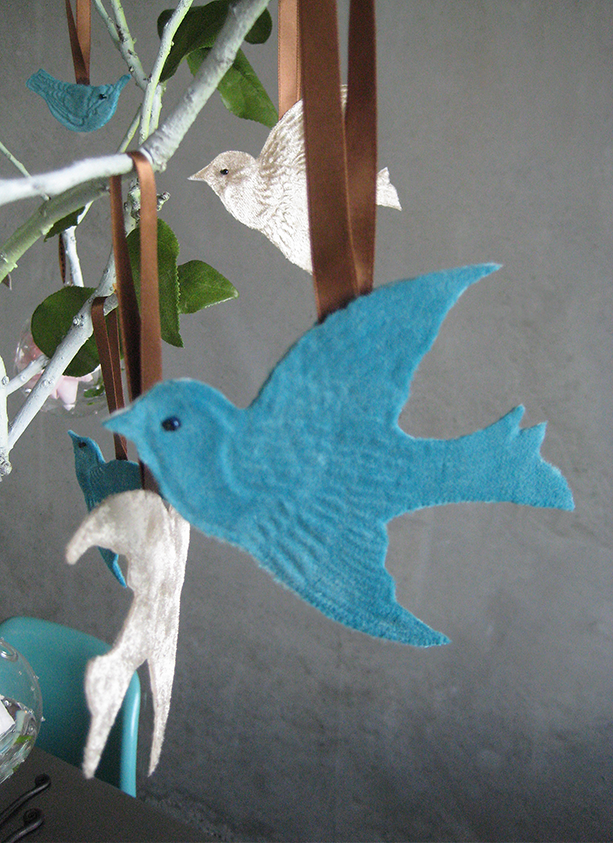
THIS YEAR'S TREE started by making crushed velvet bird ornaments with my friend Devin and took several last-minute turns to become an entire table-scape—including the crepe paper garland-wrapped trees that look for-all-the-world like fancy cakes swarmed with butterflies, dragonflies and whirlygig flowers—all trimmed with pastel-colored "candy" eggs. The place settings were pieced together from the random collection of china and tableware I have collected over the years. Strict formality is not my style, but I do like a pleasing palette along with whimsical touches such as cups with egg-shaped saucers and a "chicken foot" egg cup.

SPRING DAYS are longer and the sun is brighter making the pastel riot of flowers like roses, azaleas and tulips all-the-more appealing. All sorts of flowering trees reintroduce themselves each spring all over again. Here in the American South, the early arrival of spring has been especially vibrant because the nights have stayed somewhat cool and there has been plenty of rain along with the sunshine. The pale pink roses seen floating in glass orbs are from the a pale pink climbing rose my mother had in her yard. I took countless spring bouquets of flowers to her from this bush—the only plant I have transplanted from my childhood home. It has grown quite large as a potted rose and promises dozens of blushing-pink blooms this year.

THE SACCHARINE SWEET sanctity of the season is a celebration of spring's fertility and rebirth no matter whether it represents a resurrection or just a new beginning. It's all good when the days are warm and there is new life in evidence everywhere. Please pass me the marzipan eggs—I'll certainly toast to that!

CONICAL CONFECTIONS | (Top) I wrapped this trinity of paperboard cones with crepe paper garland from the former Backporch Friends (Cody Foster and Co.) with hot-glued wooden butterflies, dragonflies and whirlygig flowers attached to them (butterflies and dragonflies from the defunct Martha Stewart Catalog, flowers from a local antique store). I trimmed them with glittered pastel styrofoam eggs pulled from a small wreath sold this season at Target. The trees were inspired by my online stylist friend Elizabeth Demos and her use of crepe paper garland here. The three glass orbs are a past purchase from Pottery Barn and are filled with the pale pink roses snipped from my mother's old-fashioned climbing rose bush I have transplanted to Atlanta from my childhood home.

SWEET TABLEAU | (2nd from top) Using his stainless steel table, this tableau was photographed at Devin's condominium in Atlanta. Everything looked great against the mottled gray neutral of the concrete walls. The teal fiberglass school chairs were found at a thrift store in Birmingham, Alabama many years ago. The "chicken foot" egg cup is from  BIA Cordon Bleu, Inc. in Galt, California and available here. Read "Place at the Table" below for more descriptions.

BLUE VELVET | (3rd from top) These birds were made from the velvet bird kit from the defunct Martha Stewart catalog by using rubber stamps and an iron to emboss velvet backed by interfacing and gluing two sides together. Sewing a seed bead on for the eye was the finishing touch. Some scraps of robin's-egg-blue velvet were used aside from the colors that came with the kit.

PLACE AT THE TABLE | (4th from top) The place setting consisted of a charger by Isaac Mizrahi for Target, a dinner plate in the "Sculpted" pattern by Calvin Klein, egg-shaped saucers and cups with an exterior matte glaze from the Nigella Lawson collection. The ceramic tea pot/cup was designed by Michael Graves for Target. The gold and teal-striped glasses are vintage items found at an antique store. The cake pedestal and is Martha Stewart Collection at Macys. Candleholders are Martha Stewart Everyday from Kmart. Flatware is casually placed in these photos and the pattern is "Treble Clef" by Gourmet Settings.The curled unfinished handle ends resemble the unfurling frond of a fiddlehead fern has always been one of my favorite stainless patterns because of it's handmade appeal.

SWEET ENDING | (Above, bottom and left) Marzipan Easter eggs are from Biermann Marzipan in Hawthorne, New Jersey. Pastel shot glasses are from Devin's private collection. The beautiful antique Westmoreland "robin on nest" candy dish is a cherished gift from my friend Julia Carpenter from her mother's collection.

©2011 DARRYL MOLAND
ALL RIGHTS RESERVED 
Collecting and styling by Darryl Moland

Monday, March 28, 2011

a wish for Japan

EARTHQUAKE, tsunami, meltdown. The three words describing the current series of chain-reaction disasters in Japan can be expanded into describing what is happening worldwide in a broader sense. The Earth is quaking under our not-so-careful stewardship. There are waves of unrest all around the world rising in revolution. Economic upheaval is threatening a way of life we thought could continue unchecked. We are being shaken to the core. The end result of all of this is a disastrous threat of meltdown that will affect lives around the world. The relentless reality of it all is blared in the news every day. How many warning signs will it take? 

ONE HAS TO WONDER what is going on? It seems that we're having to reach for that last hope all-t00-quickly, which comes in good wishes, positive action and movement toward stabilizing our environment. Japan has always been a defiant nation of people—never to be pitied. Many countries of the world are in upheaval, whether it is because of natural disasters or man-made ones—or a combination of both. All I know that positive words and action can change a lot of things for the better. And you don't need an army to do it. The power of one can be multiplied exponentially and be heard around the world. We are all connected in a more profound way than any time in history.

IN OUR WORLD of control and containment of Mother Nature, we have lost sight of her power and the reminders are getting more and more dramatic. What does it take to awaken ourselves to the bleak future we might be creating? A plea written in my post about the Gulf of Mexico oil disaster bears repeating:

FOR  THOSE  OF  US  who consider our relationship with the natural world as something sacred, we have reached a point of no return—a point where we consider just how sacred it is to us. We are all complicit in the civilization we have created, whether it is having out-of-season produce shipped to us from continents far away or driving our cars to work. Our planet is in distress because of our actions—human actions—and the other inhabitants of this Earth, who we call "wildlife," are left unwittingly to the destruction and havoc we have wrought. At what point do the economics of a situation not matter? At what point do we shift into a collaboration with Mother Earth, instead of a war with her? We, as humans do not hold dominion over the natural world, except in its destruction.

THIS TREE is an impassioned and hopeful wish for the speedy recovery of Japan specifically, but for the whole of humanity broadly. It is all about the unity and positive drive we can have to become better versions of ourselves. We are either in-control or out-of-control when it comes to our actions. It is a simple black-and-white choice. ALL of our futures depend on it. No matter what country we call home, we are all the indisputable children of the natural world. And our Mother is crying loudly. Some of the trees I decorate have become miniature altars of sorts—like this one. This is my small way of sending out positive energy from my little corner of the blogosphere.

FULL CIRCLE | (Top) Circles of multi-colored folded cranes were made by my creative friend Jon Chavez who wanted to give me something back from a gift I gave to him that included the singular folded cranes within the gift box (bought from member Origamiyyc on Ebay directly from Japan months before this disaster). The legend goes in Japan that folding a thousand cranes makes a wish come true. It's ironic that these cranes have traveled from around the world, came back to me in a different form and are now coming to you via this post—pretty powerful stuff I would say. The dogwood branch I used is young in bloom. The legend adopted by the Christian religion says that a flowering dogwood tree was used to make the cross of the crucifixion. Whether this is a blessing or a curse depends on your beliefs. The singular crane at the base of the tree can also be seen in this post and was folded by Atlanta artisan Sachiko Kogure. The egg holder is from the Heartwood Creek collection by Jim Shore for Enesco. The egg is from this season's Easter product line at Target and is covered in origami-like paper (washi) in the style of a traditional Japanese egg decorating technique called kirigami, which uses cut paper. Eggs in the Japanese tradition represent creation, new beginnings, life and friendship.

FOLDED WISHES | (Second from top) In the case of this tree, I am using the dogwood branch to symbolize resurrection and regeneration for Japan. The multi-colored cranes represent the people of all nations coming together to assist in this effort.

LOTUS LORE | (Third from top) The lotus flower at the base of the tree is a very good faux stand-in from Michaels. The lotus flower has rich symbolism in Japan and is one of the most poignant representations of Buddhist teachings: The roots of a lotus grow in the mud, the stem rises up through the water, and the flower lies atop above the water's surface, reaching the sunlight. This pattern of growth signifies the progress of the soul from the primeval mud of materialism, through the waters of experience, and into the bright sunshine of enlightenment.

MUSHROOM LIFE | (Above, bottom) These mushrooms from Pier 1 Imports are reminders of the tenacious and magical quality mushrooms have—existing as symbols of life that pop up in a substrate of decay, adding a smiling element of surprise along with the fresh grass blades "growing" next to them. The antiqued wooden Chinese container from Homegoods stands on "stilts" above the surface of the round wooden table from Marshalls, which also represents the red circle of the Japanese flag.

PASSIONATE POSTERS | (Below) This series of inspired posters were designed by talented Japanese Canadian designer Linda Yuki Nakanishi (Left). They were created as her wish to give something back to her beloved country after realizing the gravity of the news from Japan. The descriptions below are in the artist's own words. All profits from her sale of these posters will go to the Canadian Red Cross efforts for the victims affected by the recent earthquakes and tsunamis. You can purchase one or all of them here.

MELTDOWN | This poster (Left) pays homage to the Fukushima 50 that volunteered their lives to stay behind to control the nuclear reactor. Each hexagonal shape in the Japanese pattern represents one of the Fukushima men. The crane flying up out of the nuclear meltdown represents honour, loyalty and longevity. Honour and loyalty, which was evident by the courage of the volunteers, and longevity as a wish for their safe return and health.

TSUNAMI | This is the second poster (Left) in my Japan Earthquake series. In this design I wanted to pay homage to Mother Nature. As destructive and powerful as the tsunami was, it was still an act of nature that was non-discriminating. If anything, the sheer impact of the earthquake that triggered the tsunami should be a reminder to everyone that unexpected things happen every day. Be prepared for what comes and more importantly maintaining grace under fire, like the Japanese people, when it does.

EARTHQUAKE | This poster (Left) represents the resilience of the Japanese people. The lotus symbolizes birth and rebirth, and the red lotus in particular represents love, compassion and passion (much of which is needed for the people of Japan).
The lotus is a flower that is born from the mud of the earth, fights its way through the depths of the water to bloom into the air and sunlight. This is how I view Japan, as a country that teaches their people to be strong and to endure. This is also what my parents taught me, even though we live an ocean away in Canada.

©2011 DARRYL MOLAND | ALL RIGHTS RESERVED.
Collecting and styling by Darryl Moland, 
Poster art (and accompanying text) courtesy of Linda Yuki Nakanishi.

Monday, March 7, 2011

freedom and magic


IN  A  SCENE  in a subtitled movie I watched this past weekend named "The Secret in their Eyes," you see the letter "a" added to the Spanish word temo ("fear") to form the phrase te amo ("I love you"). It was an ephiphany for me in the context of the movie and in the context of life and love in general. "Fear and love" are closely tied, even when "fear and loathing" are the words that are usually put together. Finding love again after loosing it is a fearful and arduous process. 

I  DECORATED  this tree during the Christmas holidays last year as a gift for my cousin Angela at her apartment. She had ended a long relationship with her husband a few months before and this was my way of brightening her spirit. I wanted it to represent freedom and magic—the things you possess in abundance when love is new. I wanted her to be reminded to look toward that again. When I found the carousel horse clip-on ornaments with the bright pink feather plumes, I knew I had a basis for the tree. What could be better than the freedom and magic a circus horse represents? Even though such horses are usually acting within predetermined path formed in training, one knows they are spirited animals that might just run free at any moment.

THIS  IS  THE  first tree I've put together in a long while for someone besides myself or my blog readers. Even though the bright pink feather plumes had already set me into motion, I came up with the color scheme, later finding out that hot pink and baby blue was one of Angela's favorite color combinations. She told me this when I called her up and let her know what I was thinking for her tree. I could tell the tree was going to do what I set out for it to do. Hearing from her that it made her happy was all I needed to hear. I was more than glad to help her bring that bright, glittery spot back to the forefront in her life.


HAVING  LOVED  and lost several times in my life, Angela conversely had married her high school sweetheart and was suddenly back in the world again as a single person after a very long relationship. She's quite strong and resourceful, but I knew it was a hard time for her. Realizing that love can dim over time is a huge lesson in life. It seems so natural and free (and abundant) when you're falling in love, but falling out of love is a time of reflection and soul-searching. It's a hard thing to do—to learn to love yourself enough again to engage the world in that free and magical way—the way one does when your heart is open.

IT  SHOULD  BE  a lesson for all of us that fear and love have the similar fine line between them as fear and loathing do. They both bring about the quickening of the pulse and breath and elevate all sorts of physical/chemical reactions. In each scenario though, flight is two different things. One can either run away from or run toward love. And "fight or flight" is a commonly known reaction. Sometimes it's not easy to determine just which path you're taking, or which way you have conditioned your actions. We all know actions speak louder than words.

BUT  IF  ONE  remembers the freedom found in the pure place found at the heart of things, then it's easy to gallop or fly toward the stuff of freedom and magic.

SHIMMER AND SHINE | (Top) This ice blue retro metallic tree is set in a heavy alabaster tree stand from the short-lived product catalog “Martha by Mail” a few years back. With hues of sage green, pink, blue and silver, a whimsical circus-like look is achieved, representing finding your bliss in freedom and magic.

HORSING AROUND | (2nd from top) The unusual leather-clad hand-painted zebra (I found left on a park bench without an owner) adds a fun element at the base of the tree in combination with an array of Indian mercury glass ornaments. A blue glass dish of salt water taffy completes the childlike mood.

PURITY OF HEART | (3rd from top) The German-made heart is a direct nod to the freedom found in the purity of action in opening your heart for love. The hot pink-plumed plastic clip on circus horse busts are from an inexpensive ornament 2010 line from Target. The pink, blue and sage green baubles in varying sizes are a playful way to carry out the color scheme.

FREEDOM AND WISDOM | (Bottom) Mercury glass German bird ornaments with proud silvery tails were the find of the 2010 holiday season at Homegoods. The pink owl is from the 2009 season at Urban Outfitters and is a reminder that freedom only lasts if tempered with a certain amount of wisdom.

©2011 DARRYL MOLAND | ALL RIGHTS RESERVED.
Collecting and styling by Darryl Moland, 
Photography by Troy Farina.
 

Sunday, February 13, 2011

valentine mythology


VALENTINE'S  DAY  is ripe with symbolism. A lot of people think that it's just a day dreamed up by greeting card companies to sell cards or by florists to sell flowers. It may have very well become that in modern times, but the storied mythology behind the holiday goes deeper and is richer than chocolate, roses (along with their dangerous thorns), and all the inherent saccharine sweetness of the modern holiday combined.

THIS  DAY  MEANT  for lovers has direct ties to Greek Mythology. In one such mythological tale, it seems that Apollo (Phoebus) insults Cupid (Eros) for playing with bows and arrows, boastfully asking him "What, wanton boy, are mighty arm to thee, great weapons suited to the needs of war?" Cupid was an impishly coy god of Love though, and took out his arrow and shoots Apollo with an arrow poisoning him with love for an unsuspecting wood nymph named Daphne, while also poisoning Daphne with an opposite, but equal revulsion for Apollo. Smitten with new love for Daphne, he pursues her. Of course Daphne wants no part of it and flees until her father, a river god, takes pity on her and turns her into a laurel tree, where she becomes rooted to the ground and sprouts the qualities of a tree. Apollo is undaunted and ceremoniously wears a branch that he broke from the newly transformed Daphne-as-a-tree, consecrating the tree to himself and declaring a certain victory in his plight.

IN  AN  AGE  of ecological crisis, one might assign an allegorical importance to this story by having Apollo stand in as mankind, while Daphne becomes the natural world. Our relationship with nature becomes predatory and when we fail to find harmony with it, we break off a piece of it to symbolically herald our dominion over it—wearing the laurel wreath like a champion—all the while forgetting that Mother Nature rules us, not the other way around.

THIS  VALENTINE  tree with its crumpled paper/discarded love letter background is adorned with fragile glass hearts. The beaded wire tree itself stoically rises from a faux stone. Stone hearts and chocolate heart confections vie for attention. Green roses are combined with rosemary sprigs to hold the memory of the simplest truths of love. Victory is not inherent in such a tableau, but if the ingredients are measured carefully, the combined chemistry might grow into something amazing.

ONE  MIGHT  also remember that love isn't blind and bent on a path of "having," but with finding a certain harmony in our relationships (whether it be with a person, animal or something in nature). It all happens organically, literally and figuratively. It's easy to forget that when we are consumed with an unhealthy desire to "hold" something that is constantly changing and growing. Love in its truest form helps position our deepest natural longings with a certain tempered understanding of our place within it. In this scenario, love truly does conquer all.

TREE OF HEARTS | (Top) A beaded wire tree anchored in a cement faux stone from Sundance is simply decorated with small mercury glass heart ornaments in shades of silver, violet, pink and red. Roses and rosemary sprigs in a Hotel silver trumpet bud vase stand in for the natural world. 

APOLLO CONSUMED | (Painting, 2nd from top) Apollo Chasing Daphne by Carlo Maratti, oil on canvas, circa 1681. In this painting Daphne's hands are changing into a Laurel tree while Apollo is in hot pursuit after Cupid slings arrows of love and revulsion to Apollo and Daphne respectively. Click on the portion of the painting shown here to see it in its entirety.

CONFECTIONERY HEARTS | (Third photo) I've tied this pleated foil-wrapped chocolate heart (made by Madelaine Chocolate Company) with a horizontally-striped ribbon in hues of pink and tan. The heart-shaped key lime truffle with a pink heart decal in the white chocolate coating is distributed by CVS Pharmacy, Inc. as part of a box of Absolutely Divine label premium truffles.

LOVE ON A PLATE | (Bottom) This melamine vintage graphic-printed dessert plate is by John Derian for Target. The stone hearts appearing in all of the photos are handmade Haitian stone hearts distributed by Pottery Barn, the proceeds of which go to funding the Haitian relief activities of HAND/EYE Funds Artisan Grants Program. HAND/EYE Fund works in Haiti to help artisans recover from the life-challenging loss of shelter, equipment, workshops and income due to the catastrophic earthquake.

©2011 DARRYL MOLAND | ALL RIGHTS RESERVED.
Photography, collecting and styling by Darryl Moland.

Wednesday, February 2, 2011

the year of the rabbit


AFTER  A  FEROCIOUS  Year of the Tiger in 2010, a welcome calm is marked in 2011 by the Year of the Rabbit. The Chinese calendar is based on a combination of lunar and solar movements. New Year's Eve (February 2nd this year) and the first three days of the new year are the officially observed holiday in China. The majority of businesses (with the exception of movie theaters and restaurants) close for the celebration. The Chinese people return to work between the 5th and 8th day. New Year's Day is February 3rd this year, but the spirit of the celebration lasts through the 15th day Festival of Lanterns on February 17th.

THIS  TREE  symbolically holds a diminutive ceremonial tea for Chinese New Year. Last year a client of mine gifted me a collection of miniature cloisonne teapots from China. This year these beautiful ornaments complete a symbolic set of 11 ornaments (representing the year 2011), along with four recycled newsprint ornaments shaped like lanterns. Just thinking of a ceremonial cup of tea by the light of lanterns evokes the calm and placid mood symbolized by the rabbit. The idiom "tempest in a teapot" doesn't apply here.

CLOISONNE  ENAMEL  is also called the "Blue of Jingtai" in China. Blue is the dominant color used for enameling and cloisonne became popular during the reign of Jingtai (1450-1456) in the Ming dynasty in China. The cloisonne teapots are made by the process of applying enamel to the surface of a copper or bronze object, which is then fired to become a colorful work of art. The technique was spread to China from the West and perfected by Chinese artisans.

LIGHTED  LANTERNS  appear everywhere during the Chinese New Year celebration. Fireworks are also "lit" as  a big part of the festivities. The noise of fireworks is believed to wake up the dragon who will fly across the sky to bring spring rains. Some believe that the noise of the fireworks is supposed to scare away all evil spirits, preventing them from entering the new year. In fact, gunpowder was invented in China over 1,000 years ago for that very purpose. Firecrackers are thrown at the feet of the dragons in the celebratory parade to keep them awake, since they are believed to sleep the rest of the year.  

CHINESE  NEW  YEAR  is traditionally celebrated by a religious ceremony honoring heaven and earth, the gods of the household and thanksgiving. A sacrifice to ancestors is the most vital of all the Chinese New Year rituals. Family ancestors are honored by food and incense offerings to the gods. At midnight, the celebration really begins, as it does for any New Year celebration. Fireworks fill the sky and the streets are packed with people wishing each other a happy new year. The next morning, gifts are exchanged among family members and friends, including "lucky money" given to the children in a red envelope like the one seen in the photographs here.

THE  DEMEANOR of the rabbit is the symbol for a quiet and placid year to come. Few people are aware that the rabbit is the symbol of the moon, while the peacock is the symbol of the sun. Together, these two animal signs represent Yin and Yang. Pay particular attention to the full moon this year and you just might strengthen your inner "Chi" energy and bring wisdom into your life. Here's wishing everyone a happy calm and healthy prosperity in The Year of the Rabbit.

TEA TIME | (Top two photos) Cloisonne teapots direct from China (a gift from coworker Melinda Frost) decorate this tree celebrating Chinese New Year. 

LANTERN FESTIVAL | (Third photo) Repurposed newsprint cut into fantastic lantern shapes complete the tree and sets the mood for tea. The lanterns are distributed by Roost Home Furnishings. Mine were purchased this past holiday season at Star Provisions in Atlanta. 

GROUNDED RABBIT | (Fourth photo) A mercury glass rabbit ornament is  from this past season's offerings at West Elm. An asymmetrical manzanita branch "tree" bought at Homegoods is held upright in a faux bois cast stone container. You can learn more about the art of faux bois and Mexican artisan Dionicio Rodriguez from the book Capturing Nature, written by Patsy Pittman Light. Read about the Faux Bois sculptures of Dionicio Rodriguez here at Martha Stewart Home and Garden. 

WAKING DRAGON | (Bottom photo) an accordion garland made from printed paper backed by silver (from this past holiday season's David Stark Collection at West Elm) represents the undulating dragon. The ornament ball distributed by Roost Home Furnishings is meticulously made from dozens of rolled recycled paper cylinders that evoke the omnipresent fireworks marking the New Year in China (while keeping the dragon awake). The red envelope for "lucky money" completes the picture. 

©2011 DARRYL MOLAND | ALL RIGHTS RESERVED.
Photography, collecting and styling by Darryl Moland.
Location courtesy Devin Borden.

Tuesday, January 11, 2011

frozen memories


"If there were a little more silence, if we all kept quiet . . . 
maybe we could understand something." —Federico Fellini

QUIETLY  IMAGINING  the feat of nature it takes to unite billions of singularly unique and delicate ice crystals to form a fresh blanket of snow is mind-boggling if you think about it. Memories are much the same. Thoughts guide you through the atmosphere, form together, and freeze into beautiful structures with which to blanket one's life. The transitory nature of memory is the attachment to our psyche, to something larger, to something enduring and resonant at our core—our very soul (God if you like). Snowflakes embody our attachment to nature. They literally and magically form from thin air—miraculously and mysteriously remembering how to align ice crystals into rare and beautiful structures.

The singular structure of a snowflake.
SNOWFLAKES  are only one of nature's many wonders. Some are completely symmetrical, some are columns of ice crystals, and some are their own unique shape, but their structures are astounding! It's no wonder a fresh snowfall has a magical quality. Wilson Bentley, who during a snowstorm on January 15, 1885, obtained the first photomicrographs ever taken of an ice crystal. He is credited with the oft-repeated phrase "no two snowflakes are alike." But still, they distinctly reveal nature's symmetry. A hundred years later, American physicist Kenneth Libbrecht would study and photograph snowflakes anew with much more sophisticated technology and give us hundreds of images such as the one you see here. It is as humbling as looking into the stars to see these snowflake images. They are published in a number of popular books.

FOR  THIS  to be created to make the proverbial White Christmas this past year was purely magical. Overnight, the world outside would be changed into a winter wonderland. The snow kept falling through Christmas day and night. I was fortunate enough to be with friends in a cabin in the mountains of north Georgia for the holiday surrounded by acres of pristine land. Mother Nature decorated the trees this time, not me. Being in the American South, a Christmas Day snowfall is literally a once-in-a-lifetime occurrence. There hasn't been a Christmas Day snowfall like this since 1882. As I write this, Atlanta has been put to test with another snow that has shut down businesses for two days, going on three. We're just not prepared for such weather. I, for one, have relished the peace and quiet of another magical "holiday" and spent most of the time indoors this time since the roads are icy and my workplace is closed. Staying put and embracing the silence has been welcome after a busy holiday season.

MEMORIES  ARE CAPTURED  when the world looks pristine and new again and a freshly-fallen snow helps transcend one to a place that seems otherworldly. Its transitory nature serves to remind us to take stock of its pristine beauty, knowing it will become a memory soon. A snow globe captures that bit of magic in miniature.

SNOW  GLOBES  first appeared in the late 1800s in France. The most famous being a commemorative snow globe at the World's Fair in Paris which contained a miniature Eiffel Tower. Miniature worlds for holiday memories and nostalgic keepsakes were captured within glass along with their own snowy weather system. With just a shake, a mesmerizing, lasting collectible was born. By the 1920s the snow globe had caught on across Europe and in the United States.

WHETHER GOING by the name 'snow globe,' 'snow dome,' or 'snow shaker,' they have enchanted people for more than a century. They create a hypnotic miniaturized world that is imbued with nostalgia and remembrance. Shaking the ball and watching it snow in the world within it captures the imagination.
 

SHOWN HERE  along with my small "collection" of two tree snow globes are antique ornaments to imbue a historical perspective. My favorite "globe" has a grouping of three tall evergreens and isn't a globe at all, but a column of glass in a faux birch bark base. The other is a silver winter tree in a traditionally round globe that has larger amount of snow, creating a blizzard effect that drifts down softly. I diligently photographed them in action, just as I took hundreds of photos of the Christmas snow to try and capture the magic of it all.

IT  WON'T  BE  long before all of it is just a memory again. But memories like these are the ones worth holding onto and sharing. 

SNOW MEMORIES | (Top) My two snow globes are shown with old-fashioned notebooks, ribbon and vintage ornaments. The cylindrical "globe" is from Target a few years ago and the round globe was added to my collection this past holiday season from West Elm. 

ICY PHOTO | (Above) This snowflake is one of many amazing images captured by physicist Kenneth Libbrecht who is interestingly enough originally trained as a solar astronomer. He has published several books illustrating the variety of snowflake forms, one of which I purchased back in 2005 named "The Little Book of Snowflakes." Photo © Kenneth Libbrecht by permission.

SNOW COLLAGE | (Above) That's me in the lower right corner enjoying a rare Christmas snow in Ellijay, Georgia. It was probably the most beautiful snow I've ever seen. I took quite a few photos, some of the best ones are collected here. Photo of me by Jon Chavez. 

VINTAGE DECORATIONS | (Above) Trying to evoke memory and history, I chose to photograph my snow globes atop a loose leaf notebook by John Derian Company, Inc. for Target filled with paper and an old book that has been repurposed into a newly spiral bound journal by Ex Libris Anonymous. These ornaments are of unknown provenance, but I'm almost sure the one made from bugle beads is Czechoslovakian. I buy vintage ornaments for their visual appeal, not just for their history.

SNOW-CAPPED HEMLOCK | (Above) This giant hemlock tree is deftly decorated by nature. The first clear day after the snow, the sun is peeking around the hemlock and turning the sky a beautiful pale gray/blue. 

CABIN FEVER | (Above) A friend's cabin is dwarfed by the surrounding trees. It was quite a nice place to spend Christmas this past year with Mother Nature turning the already pristine surroundings into a winter wonderland.

©2011 DARRYL MOLAND | ALL RIGHTS RESERVED.
Photography, collecting and styling by Darryl Moland, 
snow by Mother Nature.