There's no better celebration of any season than the decorated tree adorned with the rich symbolism of nature—my ritual to inform and inspire you in the journey called life.


Showing posts with label Target. Show all posts

Thursday, February 13, 2014

hearts and arrows


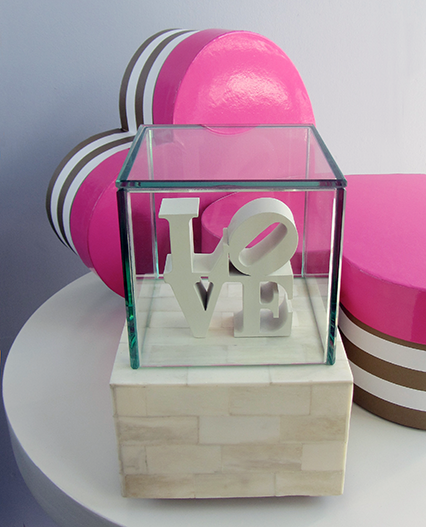
CUPID CAN BE quite a trickster. One need look no further than his choice of weapon to know that something is amiss. Arrows? Aimed at the heart? Sounds like a dangerous proposition. 

LOVE IS most certainly the finely-drawn target that we are all after, but unless the correct balance of grace, light, and levity are found in just the right proportions, it's easy to fool ourselves into thinking that we've found the love worthy of our noblest aims.

IF WE DARE open our hearts again after having them shattered, we had better be sure this time around that our little buddy cupid hasn't been off flying in the clouds for far too long. Being a romantic fool, I'm often right there with him, flitting around looking for suspects without planting my feet firmly on the ground.

LOVE IS quite a heady affair, but only becomes substantive once our arrows are sharpened and our aim is sure. It's not an easy sport at all. And it's certainly not for the faint of heart.

BUT WE KEEP getting up, brushing ourselves off and finding a way, lessons learned, to move in that direction again. A sure-fire direction of love. Because nothing else compares, and nothing else will do. After all—true love, if you've ever had it . . . well, you know the drill. And our hearts know the way.

©2014 DARRYL MOLAND | ALL RIGHTS RESERVED
collecting, photography and styling by Darryl Moland.

Saturday, February 20, 2010

the year of the tiger | 恭禧發財


HAPPY NEW YEAR! The traditional Chinese phrase: 恭禧發財 (also superimposed in photo of the decorated tree above) is the broad-brushed symbol for this sentiment. The Lunar New Year is regarded as the most important cultural holiday among Chinese, Vietnamese and other Asian nations. This year is the Year of the Tiger, which symbolizes strength. Personally, it is the to honor Luci, my beautiful Calico cat, who is a tiger in her own right. She has shown the strength to stay with me much longer than she should giving me 16 "Luci years" (all with her certain prosperity of luck, strength and beauty). I'm glad she's still with me now, but the new year will show me the strength to let her go to run with the gods.

THE NEW MOON changes are tracked by the lunisolar Chinese calendar (which consists of both Gregorian and lunar-solar calendar systems). The Chinese New Year celebration can begin anytime between late January and mid-February. This year, the 14th of February (Valentine's day) kicked off the beginning of the lunar calendar or Lunar New Year. This new beginning is the culmination of 15 days of spring festivals celebrating the event in China.

THE TREE I designed to celebrate the Year of the Tiger is inspired by the many rich traditions of the holiday. I wanted it to be a simple and elegant representation of only a few of the many and varied elements of this richly symbolic holiday. Using only mercury glass lantern ornaments in a sophisticated pallet of reds, golds and greens (from this past holiday season's Martha Stewart Collection at Macy's) hung from red cotton cords on simple natural branch forced into flower, I'm representing a time of renewal, rebirth and a precious celebration of life (honoring Luci along with the Lunar New Year).

HONG BAO NA LAI (紅包拿來) literally means "may I have the red envelope, please." Red is considered the luckiest color in China. During Chinese New Year, elders give lucky money in red envelope packets to the young people close to them, thus "hong bao" is essentially a cash gift. It is an important part of the New Year celebration. The ones you see in the photo at left have a large traditional Chinese symbol 發 (fa) with means literally "to emit," or rather "to send." It all depends on what other characters precede or follow it to complete the meaning of the expression. This one letterform symbol has more direct meaning when combined with others, but can imply so much standing alone. For instance, one can also think of it as  “to have plenty," 發財 (or "fa xai") can be translated as such.

WELL WISHES for good luck, happiness and prosperity  are the main sentiments embodied by the Chinese New Year traditions. But they are not the only ones. The celebrations are also centered around reconciliation and forgetting grudges. A clean sweep, if you will. This new year interpretation of a decorated tree is my way of relating this and more to all of the people (and little tigers) that bring the light of many multi-colored lanterns into my life. They give me the strength to recognize life's worth as clearly and as strongly as possible, seeing through the fog of uncertainty.

LANTERN FESTIVITY | (Top and middle) This "forced" tree branch is made quite elegant with the addition of mercury glass lantern ornaments from the Martha Stewart Collection 2009 at Macy's. The traditional paper lanterns used on the fifteenth day of the Chinese New Year for the Lantern Festival, are bright, colorful, and in many different shapes and sizes. The container holding the branch is an antique stoneware vase from a friend's private collection. The green spider mum symbolizing longevity (within a glass globe from Bungalow I bought a few years back, above, left) and in a vase by Victoria Hagen for Target (top), kumquats and oranges symbolizing prosperity and red envelopes (a custom explained above) are all a part of the varied traditions surrounding the holiday.

YEAR OF LUCI | This portrait of Luci (Above) was lovingly painted and given to me by Odette Colón, my dear friend (and talented co-worker) this past Christmas. When I received this incredible gift from the heart, I shed big blubbering tears of joy and grief at the same time. Looking at it prepares me for the inevitable loss of a life, and it will give me the strength to carry on after Luci is gone. I like to think all the good energy put into this painting has translated to her living longer than expected. Even so, I'm glad to have her already immortalized for the prosperity of life to continue. Already in addition to my Bengal Abella, I've added a lovable tuxedo cat that found me much like Luci did 16 years ago, coming into my life suddenly and without without warning. I think Luci somehow called for the new little one to help me in this transition. That's how magical Luci's existence has always been. And at the risk of coming off as a complete cornball, this last line of the song "Memory" from the musical "Cats" is more resonant than ever before: Look. A new day has begun.

©2010 DARRYL MOLAND | ALL RIGHTS RESERVED, collecting and styling by Darryl Moland, tree photographed by Harold Daniels Studio / assisted by Shawn May

Friday, January 1, 2010

hindsight is twenty-"ten"

LOOKING BACK as one is wont to do at the beginning of the first decade of the second millennium, it's always the practice to resolve to not make mistakes of the past. As for the future though, superstitious beliefs abound. In the American South, eating collard greens for prosperity and black-eyed peas or Hoppin' John for luck is part of the New Year's ritual. I had some of each, although on New Year's Eve at an early dinner at the Collonade. Maybe by doing that, it only helped me through the last few hours of 2009. It has not been an especially easy year for anyone (that I know, at least). Our vision is not always perfectly clear in looking back. We have to "be in the now" to really find that elusive moment of clarity. That is a resolution for anyone—to be aware of and in the moment when conducting daily life.

IT WAS THE SECOND year that I've adopted the Spanish tradition of consuming “las doce uvas de la suerte” (or the 12 grapes of luck) at the turn of the clock at midnight, along with a glass of bubbly (or wine, as we did this year). Each grape represents a month in the new year—some sour, some sweet—as I'm sure they will be. We're ushering in a new decade and have that chance again to make this the decade known for something. I'm not sure what label we'll stick on the decade that began with a two and three zeros. With the word "Twitter" being the top word of 2009 (in the English language at least), I wonder if anyone can sum up the decade in 140 characters? It has been quite a time of upheaval and limbo in many ways. 

IT'S NOT ALWAYS what we say but what we do. The following quote from one of the most notorious people in the last decade really sums up what unsettling and contemptuous rhetoric the decade has brought:
"As we know, there are known knowns. There are things we know we know. We also know there are known unknowns. That is to say, we know they're some things we do not know. But there're also unknown unknowns; the ones we don't know we don't know."
Did you get that? That quote was from U.S. Defense Secretary Donald Rumsfeld on February 12, 2002. No matter whether it effectively explained why the U.S. government had no idea what it was doing by invaded Iraq—in taking it out of context it points not so succinctly to many unsure missteps we have made collectively. 

ALL I CAN SAY is that I still believe in and wish for peace in the world. As time continues to tick away, the planet is getting smaller every day technologically and the people of the world are understaning and reasoning with each other in more civilized and succinct ways.

HATS OFF | Toasting 2010, Jon and I had a glass of wine with a skewer of 12 grapes, representing each month of the year—a Spanish tradition (above, right). The 2009 top hat ornament is from Martha Stewart Everyday Modern Celebration line at Kmart. The 2010 headband is from Target. 

TIME FOR PEACE | A delicate hourglass from Target (above, left) sits next to a past season's top-hatted Dee Foust licensed snowman figure produced by Bethany Lowe Designs that resembles an iconic New Year's image. It all overlooks a mercury glass globe ornament from my personal collection atop a glass-glittered peace sign ornament from Pottery Barn.

©2010 DARRYL MOLAND | ALL RIGHTS RESERVED 
collecting, photography and styling by Darryl Moland


REAR VIEW | This surrealist image (above) of an uprooted fir tree as car air freshener was found on a Catalonian blogger's site that commented on my blog this past August from French photographer Cédric Delsaux. I'm sharing the smile of irony it gave me. Hindsight is not unlike a rear-view mirror.


Sunday, December 6, 2009

natural selection


WE ARE NOT living in an age of subtlety. "Reality" shows abound on television where the most obnoxious, outrageous and gaudy get all the attention. No publicity, is bad publicity anymore, even for State Dinner crashers and sons of reality show wannabe parents that hold the media aloft chasing spaceship balloons for hours on end. Christmas decorations have accordingly become gaudier and gaudier in large part due to florists and department store visual display artists trying to outdo each other in public displays. That's how they sell it—build a gaudy spectacle and they will come. This is not how it should be done at home. Somebody forgot the caveat "DO NOT TRY THIS AT HOME" somewhere along the line. I remember hearing the mantra of a very successful florist — "if it's worth doing, it's worth overdoing." Not so, when decorating at home.

I CAN CERTAINLY see the m.o. in that credo, and I for one, can appreciate the glee in over-the-top decorations. There's something about gaudy American consumerist spectacle that gives me a particularly sick sort of comfort—it's as if you're not part of the game if you don't participate. More lights in more configurations than you thought humanly possible? The more, the merrier! Commercial-sized plastic blow-up yard ornaments that lie in misshapen piles while the owners are at work during the day? Not so much. It's like getting behind rubbernecking traffic in a 10-car pileup on the interstate. One just hopes they can get by without seeing a crumpled mess, or even worse, a bloody scene, but you're still stuck in the slowed-to-a-standstill traffic. Commerce has overlaid the gentle quietness of nature.

WITHIN ITS ORIGINS, the tradition of the decorated tree began with a simple, some may say, superstitious, hope for the return to spring (as if the turning of the seasons was not a surefire thing). Nevertheless, a reverence for nature is slowly being welcomed back into decorating— bringing the ceremonial symbolism and true meaning of the decorated tree back to its noble origins. A beautiful symbol of the season is a glittery tree shaped from metal "twigs" and adorned with a subdued nod to the natural world in winter whites, tans and grays (above, right). The inclusion of animal ornaments; a polar bear, a mature deer and a small bird are indicative of what can be found in the market which pay homage to endangered species. It's as if we're grasping for an apology to the natural world for what we've done to it. Aside from being visually assaulted at every turn, it is becoming more and more apparent that we are destroying our own natural environment. We have a lot to learn from the pristine natural world (both flora and fauna) in its utter grace and simplicity. No matter how breathtakingly awesome the size of its vista, the natural world, as resilient as it is, is still ultimately fragile when you look at the underlying ecosystem. Nature depends on a complex system of co-habitation and synchronization and it is less and less able to cope with the destruction wrought by humans and the waste and byproducts of industrial "civilization." Pollution comes in too many forms.

MORE AND MORE one can find natural-themed ornaments— made from eco-friendly materials (or at least not plastic or resin). Some of the first ornaments I made as a kid were from a kit my mother bought me made of felt cutouts sewn together and glued with sequins and trim, similar to the felt reindeer ornament here (but much less sophisticated, of course) that seemingly dances among the (wooden, laser-cut) snowflakes (above, left). The Germans are most famous for their glass ornaments, but are also consummate woodcrafters. The two wooden  hand-carved folk art span trees (right) are carved, amazingly enough, from a single piece of linden wood with carefully-cut shavings curled upward to form their branches—works of art in themselves that need no ornamentation. The tableau is rounded out with a couple of hand-blown, metallic-finished glass ornaments, a birch bark folded star ornament, sweetgum tree fruits painted silver (given to me by my friend Julia Neville) and a pewter leaf ornament.

THE IMAGE (at left— click on to enlarge) illustrates my point more succinctly and poignantly as only art can do. I am thrilled to have permission to show the work of a very talented artist named Jaime Zollars. In the description of this piece by Jaime, it is succinctly said: "This image of forest creatures making the best of a bleak situation illustrates hope and the true spirit of the holiday season." In remembering that true spirit, I hope this gives one pause to stop and take time to remember that nature is ultimately responsible for the bounty of the season. Look to it to inspire and inform your holiday decorations. This method to our holiday madness is something we can all hope to achieve. And by doing so, we rejoin nature on a warm wind of change. 

WINTER WISHES |  This metal wire tree from Anthropologie is coated with glittery beads and is hung with a subdued color palette of ornaments: Czechoslovakian beaded ornaments, silvery gray mercury glass baubles and German glass-glittered snowflakes demonstrate the simple composition of this tableau. Beautifully-rendered animal ornaments stand watch and remind us that their environment and ours are essentially one-in-the-same and has to be taken into account for the survival of all. 

SNOWFLAKE DANCER | The artfully, beaded and stitched felt reindeer is from Homegoods. The laser cut wooden snowflakes are from West Elm (large), Target (medium) and Anthropologie (small). 

GERMAN FOLK ART | These wooden folk art span trees are carved from a single piece of linden wood curl by curl and layer by layer with a method developed in the 1930's by talented German craftsmen (these are from Straco and purchased at Homegoods). The two handblown glass ornaments have a beautiful rich crackled "tarnished" silver finish were bought at an arts festival in Atlanta, the birch bark folded star ornament was purchased from Martha by Mail a few years back. The sweetgum tree fruit is spray-painted silver and the pewter leaf ornament came from a shop in the North Georgia mountains. 

©2009 DARRYL MOLAND | ALL RIGHTS RESERVED,
collecting and styling by Darryl Moland, 
photography (top, right) Harold Daniels Studio / 
assisted by Shawn May, 
(middle, left and bottom, right) Darryl Moland.
Artwork (bottom, left) by Jaime Zollars.
 

Saturday, October 31, 2009

tree of treats


AT HALLOWEEN, the usual distinctions between the living and the dead, children and adults, fun and fear are mysteriously blurred. The magic of the season lies in the progression of summer to fall and the onward march to winter. Autumnal colors brighten the landscape with a blaze of color, but eventually turn brown and fall to the ground to nourish the soil. It's all part of the continuous circle of life and death with the promise of rebirth in the coming spring. The Halloween tree is a recent phenomenon and is fast becoming a holiday fixture. It's fun to transform a traditional Winter/Christmas concept. 

THIS HALLOWEEN treat tree (above) is made of black crimped wire formed into a trunk with spiked branches creating a spindly silhouette. It is decorated with large metal cones painted to resemble candy corn which are filled with Halloween candy. Similarly, the first modern Christmas trees were hung with fruits, nuts, cookies and pastries. Blown glass ravens with black feather tails perch precariously and glittery wire spiders hang and crawl about—to represent the circle of life and death and pay homage to the natural world. Ravens are incredibly intelligent birds and have the ability to mimic many sounds. Because of this, they are considered wise and to possess powers of prophesy. A small autumnal tableau of pumpkins and gourds are at the base of the tree and Halloween candy is scattered about. The two pumpkins below the base are carved with a folk art tree of life and a black cat, it's back arched in classic Halloween style. The metal crow to the left is pecking at a bowl of candy treats. "Happy Halloween!" letters are strung together behind, along with a witch flying across the moon.

THE MOST CREATIVE public display of an autumnal tree I've seen was a fifty-foot tall pumpkin tree artfully composed with vines and artificial pumpkins of every shape and size. It appeared at Stone Mountain Park in the Crossroads area a few years back. I went back this year expecting to get pictures of a similar tree, but it wasn't to be found. Rarely do I see a commercially decorated tree of this size with such a magical natural-looking quality.

I JUST DISCOVERED Ray Bradbury's book, The Halloween Tree  and although I haven't read it, I'm intrigued. Below is the Amazon.com review of the hardcover edition:

. . . Eight boys set out on a Halloween night and are led into the depths of the past by a tall, mysterious character named Moundshroud. They ride on a black wind to autumn scenes in distant lands and times, where they witness other ways of celebrating this holiday about the dark time of year. Bradbury's lyrical prose whooshes along with the pell-mell rhythms of children running at night, screaming and laughing, and the reader is carried along by its sheer exuberance.

Bradbury's stories about children are always attended by dread—of change, adulthood, death. The Halloween Tree, while sweeter than his adult literature, is also touched at moments by the cold specter of loss—which is only fitting for a holiday in honor of the waning of the sun.

This is a superb book for adults to read to children, a way to teach them, quite painlessly, about customs and imagery related to Halloween from ancient Egypt, Mediterranean cultures, Celtic Druidism, Mexico, and even a cathedral in Paris. (One caveat, though: Bradbury unfortunately perpetuates a couple of misconceptions about Samhain, or summer's end, the Halloween of ancient Celts and contemporary pagans.) —Fiona Webster

FRIGHTFULLY FESTIVE | Decorating this "Halloween treat tree" (top, right), wire spiders hang from chains atop a wooden pedestal all from Pottery Barn (a few years back), while the metal crow was bought there this season. The rustic metal candy corn cones are from the workbench of Tom Guffe, created exclusively for Ohio Wholesale, Inc. and found at a shop in the Crossroads at Stone Mountain Park. The glittery spiders are from Z Gallerie. Five raven ornaments stand guard and are manufactured by the Merck family's Old World Christmas. The small matte orange and black glass baubles are from Borders. The "Happy Halloween" letter garland is from Martha Stewart Holidays and was found at Target.

PUMPKIN PRODUCTION | This incredibly artful pumpkin tree (above, left) graced the Crossroads at Stone Mountain Park in Georgia for the annual pumpkin festival for a few years. Regretfully, it didn't appear this year.

ORANGE GLOW | Ray Bradbury's original painting (left) for his classic book, "The Halloween Tree" was created in 1960.

©2009 DARRYL MOLAND | ALL RIGHTS RESERVED, collecting, photography and styling by Darryl Moland