

There's no better celebration of any season than the decorated tree adorned with the rich symbolism of nature—my ritual to inform and inspire you in the journey called life.


Showing posts with label teapot. Show all posts

Sunday, April 24, 2011

easter tableau


EASTER has always been associated with sweet spring pastel confections. I wanted to create a somewhat non-traditional scene that evoked that sweet memory of Easter. When I was a kid, I liked nothing better than waking up to a cellophane-wrapped Easter basket filled with all sorts of candy and toys. There's something about peering through cellophane that is much like peering into the window of a candy store. No wonder so many foods are packaged this way.

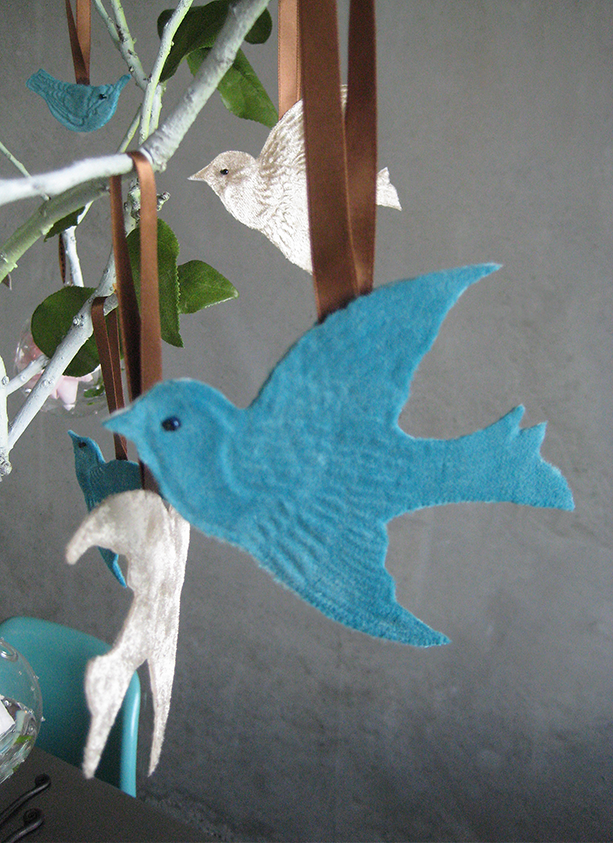
THIS YEAR'S TREE started by making crushed velvet bird ornaments with my friend Devin and took several last-minute turns to become an entire table-scape—including the crepe paper garland-wrapped trees that look for-all-the-world like fancy cakes swarmed with butterflies, dragonflies and whirlygig flowers—all trimmed with pastel-colored "candy" eggs. The place settings were pieced together from the random collection of china and tableware I have collected over the years. Strict formality is not my style, but I do like a pleasing palette along with whimsical touches such as cups with egg-shaped saucers and a "chicken foot" egg cup.

SPRING DAYS are longer and the sun is brighter making the pastel riot of flowers like roses, azaleas and tulips all-the-more appealing. All sorts of flowering trees reintroduce themselves each spring all over again. Here in the American South, the early arrival of spring has been especially vibrant because the nights have stayed somewhat cool and there has been plenty of rain along with the sunshine. The pale pink roses seen floating in glass orbs are from the a pale pink climbing rose my mother had in her yard. I took countless spring bouquets of flowers to her from this bush—the only plant I have transplanted from my childhood home. It has grown quite large as a potted rose and promises dozens of blushing-pink blooms this year.

THE SACCHARINE SWEET sanctity of the season is a celebration of spring's fertility and rebirth no matter whether it represents a resurrection or just a new beginning. It's all good when the days are warm and there is new life in evidence everywhere. Please pass me the marzipan eggs—I'll certainly toast to that!

CONICAL CONFECTIONS | (Top) I wrapped this trinity of paperboard cones with crepe paper garland from the former Backporch Friends (Cody Foster and Co.) with hot-glued wooden butterflies, dragonflies and whirlygig flowers attached to them (butterflies and dragonflies from the defunct Martha Stewart Catalog, flowers from a local antique store). I trimmed them with glittered pastel styrofoam eggs pulled from a small wreath sold this season at Target. The trees were inspired by my online stylist friend Elizabeth Demos and her use of crepe paper garland here. The three glass orbs are a past purchase from Pottery Barn and are filled with the pale pink roses snipped from my mother's old-fashioned climbing rose bush I have transplanted to Atlanta from my childhood home.

SWEET TABLEAU | (2nd from top) Using his stainless steel table, this tableau was photographed at Devin's condominium in Atlanta. Everything looked great against the mottled gray neutral of the concrete walls. The teal fiberglass school chairs were found at a thrift store in Birmingham, Alabama many years ago. The "chicken foot" egg cup is from  BIA Cordon Bleu, Inc. in Galt, California and available here. Read "Place at the Table" below for more descriptions.

BLUE VELVET | (3rd from top) These birds were made from the velvet bird kit from the defunct Martha Stewart catalog by using rubber stamps and an iron to emboss velvet backed by interfacing and gluing two sides together. Sewing a seed bead on for the eye was the finishing touch. Some scraps of robin's-egg-blue velvet were used aside from the colors that came with the kit.

PLACE AT THE TABLE | (4th from top) The place setting consisted of a charger by Isaac Mizrahi for Target, a dinner plate in the "Sculpted" pattern by Calvin Klein, egg-shaped saucers and cups with an exterior matte glaze from the Nigella Lawson collection. The ceramic tea pot/cup was designed by Michael Graves for Target. The gold and teal-striped glasses are vintage items found at an antique store. The cake pedestal and is Martha Stewart Collection at Macys. Candleholders are Martha Stewart Everyday from Kmart. Flatware is casually placed in these photos and the pattern is "Treble Clef" by Gourmet Settings.The curled unfinished handle ends resemble the unfurling frond of a fiddlehead fern has always been one of my favorite stainless patterns because of it's handmade appeal.

SWEET ENDING | (Above, bottom and left) Marzipan Easter eggs are from Biermann Marzipan in Hawthorne, New Jersey. Pastel shot glasses are from Devin's private collection. The beautiful antique Westmoreland "robin on nest" candy dish is a cherished gift from my friend Julia Carpenter from her mother's collection.

©2011 DARRYL MOLAND
ALL RIGHTS RESERVED 
Collecting and styling by Darryl Moland

Wednesday, February 2, 2011

the year of the rabbit


AFTER  A  FEROCIOUS  Year of the Tiger in 2010, a welcome calm is marked in 2011 by the Year of the Rabbit. The Chinese calendar is based on a combination of lunar and solar movements. New Year's Eve (February 2nd this year) and the first three days of the new year are the officially observed holiday in China. The majority of businesses (with the exception of movie theaters and restaurants) close for the celebration. The Chinese people return to work between the 5th and 8th day. New Year's Day is February 3rd this year, but the spirit of the celebration lasts through the 15th day Festival of Lanterns on February 17th.

THIS  TREE  symbolically holds a diminutive ceremonial tea for Chinese New Year. Last year a client of mine gifted me a collection of miniature cloisonne teapots from China. This year these beautiful ornaments complete a symbolic set of 11 ornaments (representing the year 2011), along with four recycled newsprint ornaments shaped like lanterns. Just thinking of a ceremonial cup of tea by the light of lanterns evokes the calm and placid mood symbolized by the rabbit. The idiom "tempest in a teapot" doesn't apply here.

CLOISONNE  ENAMEL  is also called the "Blue of Jingtai" in China. Blue is the dominant color used for enameling and cloisonne became popular during the reign of Jingtai (1450-1456) in the Ming dynasty in China. The cloisonne teapots are made by the process of applying enamel to the surface of a copper or bronze object, which is then fired to become a colorful work of art. The technique was spread to China from the West and perfected by Chinese artisans.

LIGHTED  LANTERNS  appear everywhere during the Chinese New Year celebration. Fireworks are also "lit" as  a big part of the festivities. The noise of fireworks is believed to wake up the dragon who will fly across the sky to bring spring rains. Some believe that the noise of the fireworks is supposed to scare away all evil spirits, preventing them from entering the new year. In fact, gunpowder was invented in China over 1,000 years ago for that very purpose. Firecrackers are thrown at the feet of the dragons in the celebratory parade to keep them awake, since they are believed to sleep the rest of the year.  

CHINESE  NEW  YEAR  is traditionally celebrated by a religious ceremony honoring heaven and earth, the gods of the household and thanksgiving. A sacrifice to ancestors is the most vital of all the Chinese New Year rituals. Family ancestors are honored by food and incense offerings to the gods. At midnight, the celebration really begins, as it does for any New Year celebration. Fireworks fill the sky and the streets are packed with people wishing each other a happy new year. The next morning, gifts are exchanged among family members and friends, including "lucky money" given to the children in a red envelope like the one seen in the photographs here.

THE  DEMEANOR of the rabbit is the symbol for a quiet and placid year to come. Few people are aware that the rabbit is the symbol of the moon, while the peacock is the symbol of the sun. Together, these two animal signs represent Yin and Yang. Pay particular attention to the full moon this year and you just might strengthen your inner "Chi" energy and bring wisdom into your life. Here's wishing everyone a happy calm and healthy prosperity in The Year of the Rabbit.

TEA TIME | (Top two photos) Cloisonne teapots direct from China (a gift from coworker Melinda Frost) decorate this tree celebrating Chinese New Year. 

LANTERN FESTIVAL | (Third photo) Repurposed newsprint cut into fantastic lantern shapes complete the tree and sets the mood for tea. The lanterns are distributed by Roost Home Furnishings. Mine were purchased this past holiday season at Star Provisions in Atlanta. 

GROUNDED RABBIT | (Fourth photo) A mercury glass rabbit ornament is  from this past season's offerings at West Elm. An asymmetrical manzanita branch "tree" bought at Homegoods is held upright in a faux bois cast stone container. You can learn more about the art of faux bois and Mexican artisan Dionicio Rodriguez from the book Capturing Nature, written by Patsy Pittman Light. Read about the Faux Bois sculptures of Dionicio Rodriguez here at Martha Stewart Home and Garden. 

WAKING DRAGON | (Bottom photo) an accordion garland made from printed paper backed by silver (from this past holiday season's David Stark Collection at West Elm) represents the undulating dragon. The ornament ball distributed by Roost Home Furnishings is meticulously made from dozens of rolled recycled paper cylinders that evoke the omnipresent fireworks marking the New Year in China (while keeping the dragon awake). The red envelope for "lucky money" completes the picture. 

©2011 DARRYL MOLAND | ALL RIGHTS RESERVED.
Photography, collecting and styling by Darryl Moland.
Location courtesy Devin Borden.

Tuesday, June 8, 2010

white wedding


WHO  KNEW?  Queen Victoria wore a white wedding dress. That in itself may not seem like news at all, but since she's widely credited with starting the tradition, it's a revelation. It followed that Victorian era elites, rapturously reading and writing the etiquette books of the day, took Victoria's lead and embellished it with the "connotation of innocence and sexual purity." 

FAST  FORWARD to over a century later and the Billy Idol song "White Wedding" served to heighten the fantasy of a virgin bride. Some say that he wrote the song to express his displeasure with his sister's fiancé impregnating her before marrying her. It was a nice day (meaning the '80s) for a white wedding, because it was one of Idol's most successful songs.

VICTORIA and husband/cousin Albert are also subsequently credited for popularizing the modern Christmas tree. Either alone is a testament to the great effect these kissing cousins had on modern culture. She was the longest-ruling monarch of Great Britain (64 years!), during a time of economic and imperial expansion (Albert died early in 1861). Victoria gave her name to the Victorian Era, but she was also nicknamed the "grandmother of Europe" since the fruitful couple had four sons and five daughters to keep the royal lineage going for decades to come (42 grandchildren).

“Married in white, you will have chosen all right. Married in gray, you will go far away. Married in black, you will wish yourself back. Married in red, you’ll wish yourself dead. Married in blue, you will always be true. Married in pearl, you’ll live in a whirl. Married in green, ashamed to be seen. Married in yellow, ashamed of the fellow. Married in brown, you’ll live out of town. Married in pink, your spirits will sink.”

—From The History of the White Wedding Dress by Kelsey McIntyre

IN  ANY  CASE, weddings are steeped in tradition, rituals and superstition all-at-once. A bridal set of ornaments is an elegant gift that brings the seasons all together in one set, whether used only around Christmas or separately throughout the year, or both. A wedding in June—is surprisingly only the second most popular month for weddings—even with the "June bride" being part of the cultural dialog. June falls just below September in wedding month popularity (according to the Knot). Victoria and Albert's wedding date was February 10, 1840, so the June bride didn't start there (that may go back to Roman times). In true Victoria (not Victorian) form, it seems like the only tradition today is to break with tradition, making your wedding unique—a reflection of your own personal style. Maybe, also, one day it won't be so unique for gay people to legally marry in this country and it will be passed into law, for better or worse. I doubt if it will interfere with the sanctity of marriage. And it certainly is better than marrying your cousin. Being a gay man from Alabama, I can say that with hope and conviction, having been in two long-term, live-together relationships, nine and six years respectively, both with whom I still maintain good friendships.

ACCORDING  TO  German tradition, a set of  bride's tree ornaments (all photos this post) are twelve symbols of a happy home—a nice gift to wish the newlywed couple success in marriage and life. Follow the numbers to find the meaning, ritual or superstition behind each:

1) BIRD | symbol of joy and happiness
2)
ANGEL | symbol of guidance
3)
RABBIT | reflects hope and peace with nature
4)
FRUIT BASKET | symbolizes generosity and plenty
5)
HEART | symbol of true love
6)
PINE CONE | represents motherhood and fruitfulness
7)
FLOWER BASKET | symbolizes good wishes or beauty in the home 
8) ROSE | symbol of affection  
9) HOUSE | represents protection or shelter
10)
FISH | represents fertility and faith
11)
TEAPOT | represents hospitality
12)
SANTA | is a symbol of goodwill, giving and sharing

WRAPPING an heirloom such as this set of ornaments warrants a reusable box with protective squares of archival tissue. I've added squares of wide shimmery organza ribbon as an accent. The bride's ornament set can be found in pre-packaged gift-boxed sets, but since this set was found individually, an ornament box was necessary to contain it. This starter set of holiday ornaments can be used together at Christmas or individually, according to the season. Small inexpensive honeycomb wedding bells are a nice topper to the gift instead of a traditional bow (they can also be positioned half-opened, taped to the top of the wrapped box).

WEDDING TABLEAU | (Top) This unusually neutral white and silver bride's tree set was found individually a few seasons ago at Star Provisions in Atlanta. I had to replace the original house ornament which was broken with a similar one from the grand daddy of the German glassblowing tradition, Krebs Lauscha. (Center) I've numbered the set of ornaments to correspond with the list of their meanings. (Bottom) If found individually, it's a nice gesture to archive the ornaments for gift-giving and keeping. The linen napkin with beautiful silver-threaded stitching is by Thomas O'brien, from his Vintage Modern line for Target in 2005. The paper daisies were found at Michaels and the honeycomb wedding bells are from Martha Stewart Crafts.

©2010 DARRYL MOLAND | ALL RIGHTS RESERVED
photography and styling by Darryl Moland